
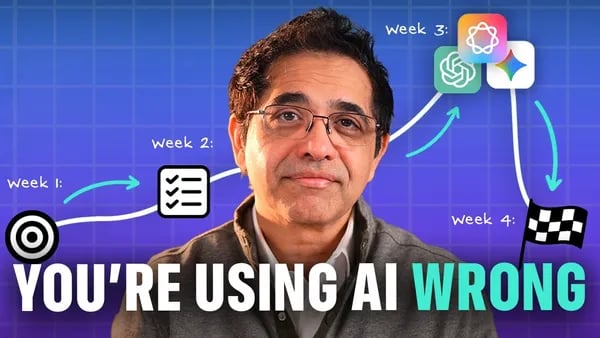



Mastering AI in 30 Days: My Roadmap for Beginners
After 20+ years in tech, I've noticed something kinda funny. Most people are using AI all wrong. Like, really wrong. That's why it's still pretty easy to outpace 99% of users. The gap between AI-savvy folks and everyone else? It's getting wider every day.
So here's the deal. I've put together a 7-step roadmap to master AI like the top 1%. And yeah, I honestly believe anyone can do this in just 30 days - even total beginners. Seriously.
Let's start with what I call "machine English." Most people talk to AI like it's human, but that's not how generative AI systems work. ChatGPT, Gemini - they don't understand language. They predict it. Think about how Google finishes your sentences when you type. Similar idea.
These systems break text into tokens (words or parts of words) and convert them into vectors in this crazy mathematical "embedding space." Related ideas sit close together. For example, "Humpty," "egg," "wall," and "fall" are neighbors in this space, while "motorcycle" is way off somewhere else. The tokenization process is fascinating - when prompted, the AI checks context and predicts the next token based on probability, not from memory. So vague prompts? Vague results. Duh.
I've found the AIM structure works wonders: Actor, Input, Mission. Tell the AI who to be, give it context, and clearly state what you want. Instead of "fix my resume," try "Act as a top resume editor. Here's my resume and a job description for a fintech PM role. Give me 10 specific improvements." The difference is night and day.
But here's where people mess up. They jump between fifty different AI tools without mastering any. Bad move! Pick ONE foundational model - ChatGPT, Gemini, Claude, whatever - and go deep. Spend a week getting to know its personality. It's like learning the rhythm of a dance partner.
Context matters too. AI models are just mathematical representations until you give them direction. I use the MAP framework: Memory (conversation history), Assets (files/data), Actions (web searches, etc.), and Prompt. Better context = better results. Simple as that.
When things go wrong? I don't blame the AI. I debug my own thinking. Did I give the right context? Was my goal clear? Sometimes I'll even ask the AI to explain its process - you'd be surprised what you learn about semantic relationships and embedding layers!
Look, mastering AI isn't rocket science. But it does take practice. Over 30 days, you'll train both the model AND yourself. Each prompt becomes a conversation, not just an instruction.
I truly believe AI isn't here to replace us but to make our work more meaningful. Pretrained tokenizers and language model training might sound technical, but they're just tools. Tools that anyone - yes, even you - can learn to use brilliantly.
What's your experience with AI so far? Have you tried structured prompting? Let me know in the comments!