
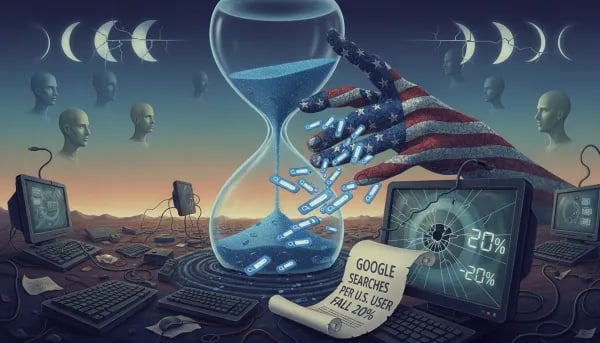


I remember the first time I noticed my own search habits change: a single, complete answer in the results and no reason to click further. That small, slightly unnerving shift is exactly what Datos and SparkToro quantified in their Q4 2025 analysis — U.S. Google searches per user fell nearly 20% year over year. In this outline I walk through the numbers, the AI undercurrents, and what those changes mean for publishers and marketers — in plain, sometimes opinionated terms.
Core finding: Searches per U.S. user fell nearly 20% (core finding)
In the Datos/SparkToro Q4 2025 State of Search, the core finding is clear: Google searches per U.S. user on desktop fell nearly 20% year over year (2024→2025). Datos measured this using clickstream data from tens of millions of U.S. users, and the drop stands out because Europe and the EU/UK saw only a 2–3% decline in searches per.
Even with fewer searches, traditional search still made up about ~10% of all U.S. desktop activity across 2025, staying almost flat. I read this as fewer repeat follow-ups, not people leaving Google.
"Nearly 20% YoY decline in Google searches per U.S. user is the headline we can't ignore." — Rand Fishkin
Why it happened: AI cuts repeat searches (AI cuts)
I see AI cuts as the main reason search behavior shifted: AI-powered answers and instant results reduce repeat searches and follow-ups. AI isn’t pulling people away from Google; it’s being layered into the results, so one query often does the work of two or three.
That also explains why zero-click searches stayed high but stopped climbing, stabilizing in the low-20% range by the end of 2025. Users still don’t always click, but the pattern looks steady, not accelerating.
- AI tools were just 0.77% of U.S. desktop activity
- AI mode (Google AI Mode) was 0.06% by December 2025
"AI-provided answers are fundamentally altering users’ engagement, often resolving queries before there is any need to click." — Rand Fishkin
Query evolution: longer, more complex searches (query evolution)
I noticed clear query evolution in the Datos/SparkToro data: query length is rising as U.S. search behavior shifts. Mid-length queries (6–9 words) were the fastest-growing segment in 2025. Very long queries (15+ words) stayed rare, but their volatility suggests people are testing more expressive prompts.
"Users are experimenting with longer queries as AI gets better at parsing nuance." — Danny Goodwin
To me, this lines up with AI-powered answers and broader AI-driven adoption: users ask fuller, more nuanced questions and expect one result to cover the whole intent, which can reduce repeat searches and limit discovery across the long-tail web.
- Write titles/meta that match full questions.
- Track query-length distribution and CTR as a KPI.
Zero-click and post-search destinations (post-search destinations)
When I look at search destinations and post-search destinations, the same giants still shape U.S. search behavior and discovery patterns. YouTube Reddit, Amazon, Wikipedia, and Facebook remain the stable leaders users land on after Google.
- ChatGPT growth: ChatGPT climbed to #7 among U.S. search destinations in 2025.
- Quora: Quora dropped out of the top 15, signaling weaker search-driven visibility.
- AI referrals: Most still flow to Google, YouTube, GitHub, and Wikipedia, not smaller sites.
"ChatGPT's climb to #7 is one of the few big shifts in destination rankings." — Rand Fishkin
AI tools landscape and adoption (AI-driven adoption)
I see an AI tools market that’s growing, but still small next to Google. In 2025, all AI tools combined were just 0.77% of U.S. desktop activity, and AI mode inside Google (Google AI Mode) was only 0.06% by December.
Within that small footprint, ChatGPT growth stands out: it leads in the U.S., reaching roughly 25–33% of desktop AI users. Google Gemini is the clear #2 and surpassed DeepSeek during 2025, while Claude, Perplexity, and Copilot remain niche. Even so, one measure suggests ChatGPT handles about 1/373 of Google’s daily searches, which frames the current AI impact as real but not yet dominant.
"Google’s Gemini emerging as a clear number 2 shows steady competition but no single breakout winner yet." — Danny Goodwin
Impact on publishers: tougher discovery and long-tail loss (tougher discovery)
I confess I’ve felt the tougher discovery squeeze on my own sites: fewer repeat searches means fewer chances for niche pages to earn clicks and publisher traffic. Datos/SparkToro backs this up—Rand Fishkin says, “Google is sending less traffic, particularly to the long-tail of the web.” That long-tail web loss is amplified by AI overviews and instant answers, plus traffic concentration toward YouTube, Reddit, Amazon, Wikipedia, and Facebook.
"Google is sending less traffic, particularly to the long-tail of the web." — Rand Fishkin
In this new discovery era, I’m watching the debate intensify: related coverage says ~1/3 of publishers plan to block Google’s AI-generative features. Search Engine Land (owned by Semrush) frames this shift for marketers with tools and research.
Practical advice for marketers and a few wild cards (search behavior)
I plan for fewer repeat searches by matching real search behavior: target mid-length queries (6–9 words), add structured data, and place AI-powered answers high on the page so snippets can cite me. I also build “single-answer” pages that satisfy full intent in one visit, since searches per U.S. user fell nearly 20%.
Because discovery is getting tougher discovery-wise, I diversify beyond Google organic with YouTube, Reddit, Wikipedia, and GitHub, and I use Semrush tools plus technical SEO audits to track shifts in referrals.
“Adaptation means optimizing content so AI and SERP features surface you rather than silence you.” — Danny Goodwin
Monthly, I watch zero-click share (low-20%), desktop AI share (0.77%), and Google AI Mode events (0.06%). If ChatGPT becomes a main layer, I lean into email lists and direct traffic; if publishers unite to block or negotiate, I keep contingency plans ready.