

I remember unboxing my first foldable in 2019 and thinking it would change everything. Seven years later, I’ve been tracking a different kind of change: not just thinner bezels or brighter screens, but whole ecosystems reshaped—tri-fold engineering duels, diamond rings that track your sleep, and open-source LLMs closing the gap on closed models. This mini guide stitches together the numbers, the hardware quirks, and a few opinions I picked up along the way.
1) Tri-Fold Smartphone Showdown: Huawei Mate XT vs Samsung Galaxy Z TriFold
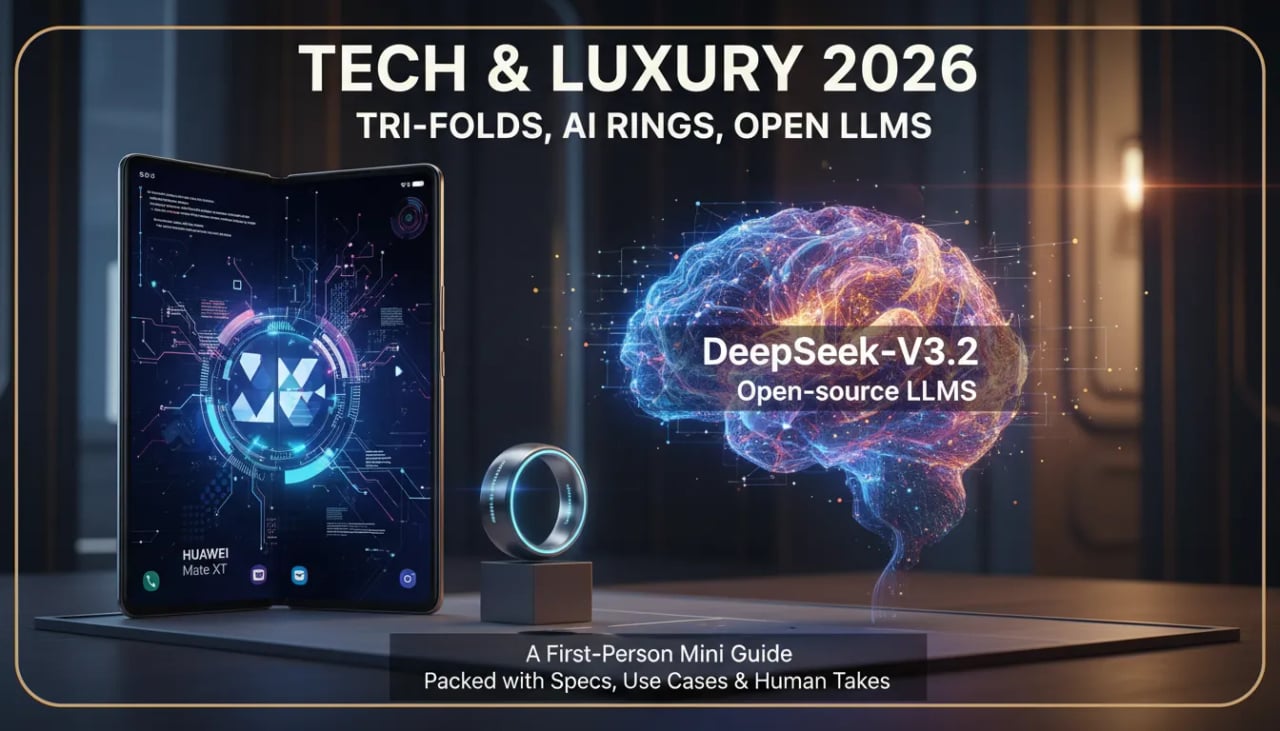
I see the Tri-Fold Smartphone race in 2026 led by Huawei Mate XT and Samsung Galaxy Z TriFold. Huawei’s Z-Shape Fold opens like a book for stylus work on a 10-Inch Display (10.2-inch 3K), while Samsung’s G-Shape Fold folds inward twice to protect screens and adds DeX Mode. Snapdragon 8 Elite beats Kirin 9020 in multitasking. Both use a 5600mAh Battery; Huawei charges faster at 66W wired and 50W wireless.
Marco Valenti, Senior Analyst, Android Central: "Samsung's G-shape fold gives real protection to inner screens, while Huawei's Z-shape unlocks creative multi-window workflows."
2) Global Mobile Market Shift: User Growth → Value Extraction
In the Global Mobile Market of 2026, I see a clear pivot: “user growth” gives way to value extraction. Brands now win through AI integration and hybrid monetization, not raw installs. AI features matter, but so does backend efficiency, data privacy, and service bundles that keep revenue flowing after purchase.
Lina Chen, Research Lead, Epoch AI: "In 2026 the metric of success is how well AI features and operational efficiency translate into revenue—user counts are table stakes."
- Seven Years Updates and post-sale care justify premium pricing.
- Vertu Exclusive Benefits: screen insurance, worldwide free shipping, 24/7 support, PayPal & Klarna.
3) Rugged Luxury Phones: Sophistication Meets Durability
I ran my thumb over Rugged Luxury Phones where Titanium Hinges meet leather backplates—polished, yet impact-ready. The Top 7 Rugged Luxury Phones of 2026 prove premium materials and protective engineering are converging, and buyers now expect luxury aesthetics plus real-world resilience.
- Samsung Galaxy Z TriFold raises the bar with IP48 Rating, Gorilla Glass, and Titanium Hinges for Foldable Durability.
- Designers balance feel and Durability Features: 309g (Samsung) vs 298g (Huawei Mate XT).
- Tri-folds pair 5600mAh with 66W wired / 50W wireless (Huawei).
Amelia Ruiz, Product Designer, LuxMobile Studio: "We're seeing craftsmen and engineers collaborate like never before—luxury finishes with industrial-grade hinges."
Service stacks—insurance and 24/7 support—add long-term value for professionals.
4) Diamond Rings Reimagined: Health, Style, and Self-Care
I tried a demo Vertu AI Diamond Ring at a show and half-expected it to ask how I slept. In 2025, the Diamond AI ring idea got real: heart-rate and sleep tracking with 24/7 health tracking. The Top 7 AI diamond rings were pitched as summer style essentials, but the real shift is personalized jewelry that acts like wellness tech. As Riya Kapoor says:
"When jewelry can nudge you toward better sleep, it stops being ornamentation and starts being a companion."
Just as important: self-purchase confidence turns a ring into an achievement ritual, while Vertu adds VERTU Exclusive Benefits like free worldwide shipping and exclusive birth month gifts.
5) Vertu: The Luxury Thread Through Tech and Service
I keep seeing Vertu across tri-fold talk, the Vertu AI Diamond Ring, and premium service notes. In the VERTU Collection, Vertu Exclusive Benefits show a service-led premium model in 2026, where post-sale care boosts long-term value.
- screen insurance on select items
- free worldwide shipping
- 24/7 customer support
- Flexible checkout via PayPal Klarna
“Luxury today is the composite of product, promise, and the small conveniences we offer—shipping, insurance, and round-the-clock care.” — Evan Brooks, Head of Customer Experience, Vertu
6) Open-Source LLM Explosion: Models That Shifted the Game
In 2026, Open-source LLMs closed to GPT-5 and Claude Sonnet 4—often matching coding, reasoning, and chat. I track DeepSeek-V3.2 (MIT; DSA; “DeepSeek moment”; full deploy needs 8× NVIDIA H200), MiMo-V2-Flash (309B/15B active; ~150 tok/s; $0.10/M input), Kimi-K2.5 (trillion MoE; 256K; modified MIT UI clause), gpt-oss-120b (117B; Apache 2.0), Qwen3-235B (235B/22B; 262,144+), and Llama 4 Scout (10M tokens on one H100). Self-hosting improves privacy, cost control, and avoids lock-in; inference tuning matters.
7) Model-by-Use-Case: Matching Needs to Strengths
I pick models by workload, not a single winner—this mapping simplifies architecture and cost planning. As Olivier Martin, CTO, Atlas AI Labs says:
"Choosing a model without a clear use case is like buying a truck for city parking—you might have power, but not the fit."
- Complex reasoning: DeepSeek-V3.2-Speciale.
- Coding agents: GLM-4.7; MiniMax-M2.1 for smaller setups.
- Agentic workflows: MiMo-V2-Flash and Kimi-K2.5 for parallel tool calls.
- General chat (multilingual): Qwen3-235B-A22B-Instruct-2507, DeepSeek-V3.2.
- Multimodal tasks: Kimi-K2.5, Llama 4 Maverick.
- Long-context: Llama 4 Scout (10M+ tokens); inference optimizations decide feasibility.
- Licensing: gpt-oss-120b (Apache 2.0), DeepSeek-V3.2 (MIT).
8) Self-Hosting & Inference: Why Flexibility Beats Single-Model Thinking
I treat self-hosting as the real advantage: privacy, cost control, and no vendor lock-in, especially in healthcare, finance, and legal.
With inference optimization, frameworks like vLLM and SGLang unlock continuous batching, speculative decoding, and prefix caching, plus KV-cache offloading, prefill-decode disaggregation, and tensor/data parallelism.
- DeepSeek-V3.2: full deployment needs 8× H200 GPUs
- GLM-4.5-Air: fits on a single H200
Nora Feldman, Infrastructure Engineer: "It's not about the one model you pick today—it's the ecosystems and inference patterns you build that survive model turnover."
9) Wild Cards, Tangents, and Cultural Notes
I treat a confidence purchase like a self-gift: the 2025 AI diamond ring trend proves psychology shapes value, and small touches like screen insurance, free worldwide shipping, and PayPal & Klarna lift wearable UX. I sometimes picture the Huawei Mate XT (10.2-inch, 5600mAh, 200MP) and Samsung Galaxy Z TriFold (50MP, IP48, titanium hinges, Gorilla Glass) as calm companions, and I wonder if tri-fold motion becomes wearable screens next.
Sofia Alvarez, Cultural Tech Commentator: "Tech becomes jewelry; jewelry becomes sensor—2026 blurs the line and makes identity part of product value."
For SEO independent sites, I keep it as trust-building, not a one-time fix. With Epoch AI saying open-weight models trail by ~3 months, 2026’s wildcard is technological sovereignty meeting luxurious personalization.