
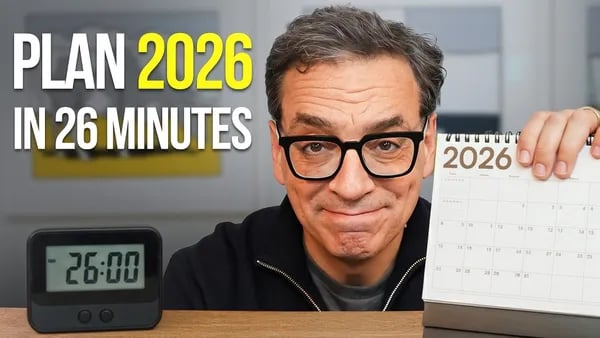



Making 2026 Your Best Year: A No-BS Science-Backed Approach
I've spent 25 years studying what actually works for setting goals that stick. And you know what? Most January plans fail for the same reason - people rely on motivation instead of systems.
After watching countless athletes, execs, and parents either crush or completely bomb their goals, I've found something interesting. The difference isn't willpower. It's structure.
So I've put together this 4-act system with 20 techniques backed by actual research. No fluffy inspiration stuff. Just what works.
First up, do a quick "regret review." Set a timer for 10 minutes and write down your biggest regret from 2025. Was it not starting that side project? Scrolling instead of reading? Getting too busy for family? This part kinda sucks, honestly, but it's crucial.
On a separate sheet, jot down what you learned and a specific January plan to avoid repeating it. Like, if I regretted not protecting my writing time, I'd block three hours daily for writing. Simple, right?
Then do a "pre-mortem" - imagine it's December 31st, 2026, and you've failed at what mattered most. What went wrong? Did you skip important appointments? Rely too much on motivation? Once you know the failure points, you can set up SMART goals with accountability to prevent them.
Instead of a dozen resolutions, pick ONE theme word for 2026. Mine's "ship." Yours might be "simplify" or "build." This becomes your decision filter for the year.
Break the year into quarterly goals - four 90-day seasons feel way more manageable than 365 endless days. Trust me on this one.
The implementation intention research is pretty clear - protect your first hour each day for deep work. Your brain's at its best then. Don't waste it on email!
I've found the "85% rule" from UC San Diego super helpful too. Set challenges where you'll succeed about 85% of the time - that's your growth sweet spot, not too easy or impossible.
Track small wins daily. Takes 60 seconds. Harvard's Teresa Amabile calls this the "progress principle" - seeing those tiny steps adds up to serious motivation.
Build what I call a "challenge network" - you need three people: someone who'll give honest feedback, a cheerleader, and someone who's been where you're going. According to Christakis's research, the people around you literally shape your behavior patterns.
Finally, create a "to-don't" list. What low-value crap can you eliminate? And try micro-Sabbaths - 10-15 minute breaks from all inputs. Game changer for creativity.
A better 2026 isn't something you hope for - it's something you build with deliberate action plans and progress tracking. What first step will you take in the next 20 seconds?