


Mastering the Art of Learning: Lessons From My Journey
Growing up poor in Mumbai, I struggled big time with learning. School was rough for me. Yet somehow, I ended up graduating from MIT, becoming a CEO, and advising billion-dollar companies. How? Not because I'm super smart or read more books than everyone else. Nope. I just figured out how to learn faster than the people around me.
Here's the thing about today's AI-dominated world - being smart isn't special anymore. Any skill advantage you have? Temporary. The real edge comes from how quickly you can learn and adapt. That's it.
Ever wonder why most people fail at learning effectively? Our brain weighs just 3 pounds but uses a whopping 20% of our body's energy! The prefrontal cortex—basically the CEO of your brain—is especially hungry when processing new stuff. Think of it as a tiny "cognitive bowl" with limited capacity. Try pouring a gallon of information into a 4-ounce container and... well, you get the picture. We're built for serial processing, not parallel. No wonder cramming never works!
Our brains actually lie to us about learning. A Carnegie Mellon study on adaptive learning technologies showed that students hated when material got harder based on their success—but they learned twice as much! This is the "generation effect" in action: struggling creates deeper, more durable learning. But most people use AI as a crutch instead of a coach. Your brain actually craves that challenge.
So what's the solution? I've developed what I call the 3C protocol for effective learning strategies:
First, Compress. Like chess grandmasters who internalize thousands of board patterns, you need to chunk information. Your working memory prefrontal cortex can only juggle about four ideas at once. Focus on the vital 20% that delivers 80% of the value, then connect new ideas to stuff you already know.
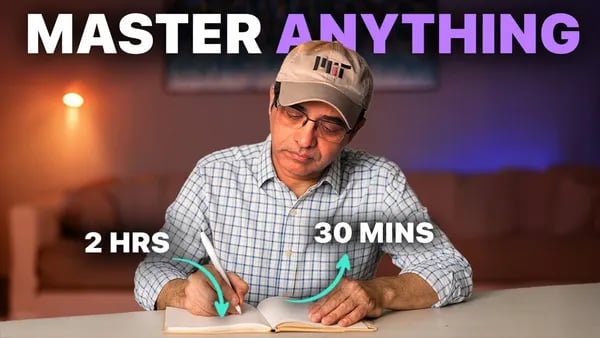
Second, Compile through active learning engagement. Memory alone isn't mastery (just ask Kim Peek, who memorized 12,000 books but couldn't navigate daily life). Use the ultradian cycle—90 minutes of focus followed by 20-minute breaks. During breaks, I practice Non-Sleep Deep Rest. Just lie down and do nothing. Seriously.
Last, Consolidate with rest. Learning happens in two stages: focus and rest. Your brain needs both microlearning short segments and proper sleep for memory retention learning. Sleep actually replays what you learned in reverse order! Farmers have always known fields need rest periods—your brain's the same.
In my experience, the best learners understand this natural rhythm. Stop comparing yourself to others—your only competition is yesterday's version of you. Shift from critic to performer. Be patient. Learning's like an ocean with its own ebb and flow.
These techniques changed my life. They can change yours too. Trust me, with the right approach to spaced repetition technique and learning consolidation rest, there's nothing you can't learn.
Found this helpful? Subscribe for more! The journey to master learning never really ends—it just gets more interesting.